How laser cutting machine works to cut solar cells into small pieces according to your solar panel design?
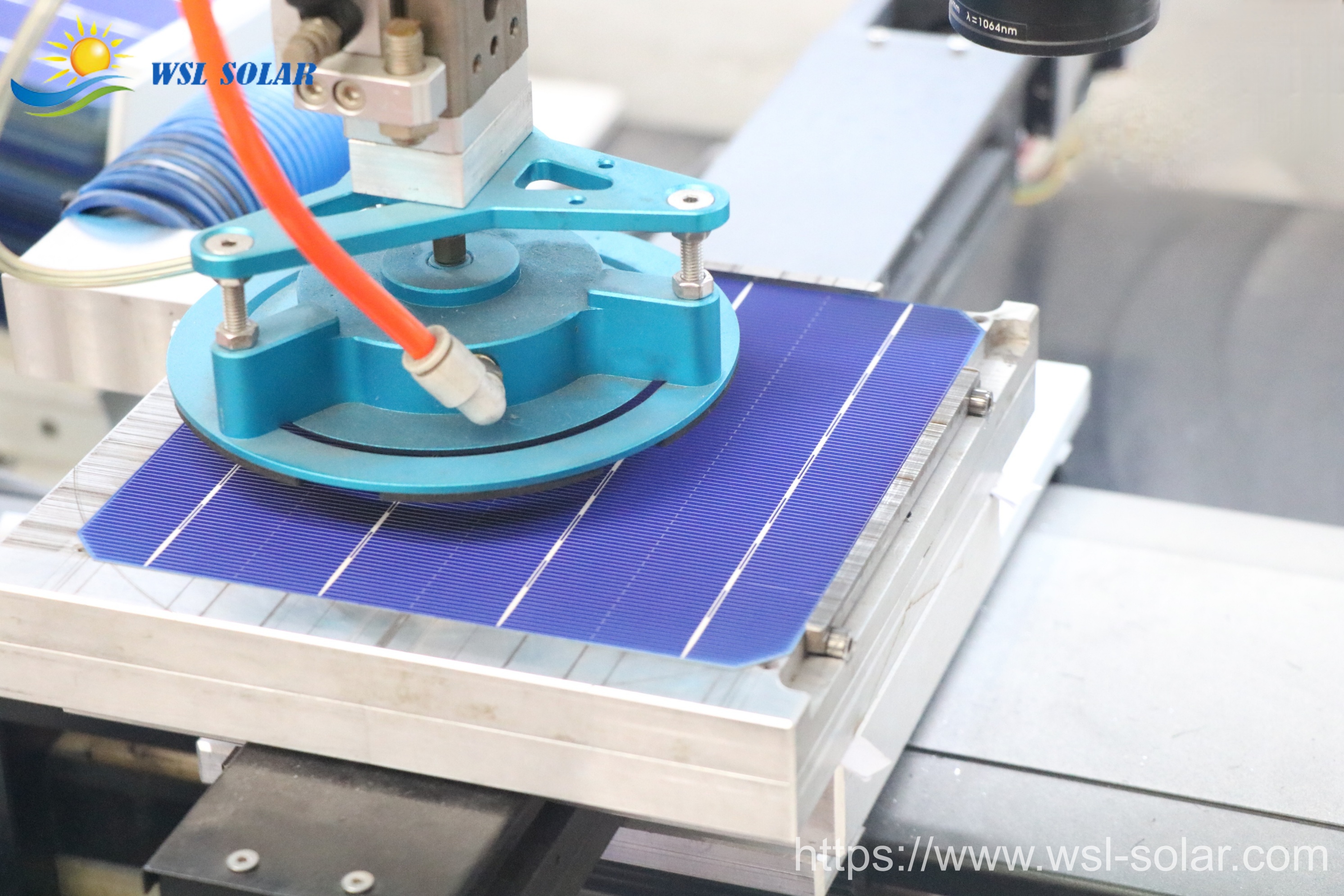
Cutting solar cells into small pieces is a critical process in solar panel manufacturing, especially for high-efficiency custom solar panels with specific designs. Here’s a detailed breakdown of how laser cutting works for solar cells.
The Core Principle: Controlled-Fracture Cleaving (for Monocrystalline Cells)
The most common method doesn't "burn" through the silicon like a traditional laser cutter might with metal. Instead, it uses a highly focused, low-power laser to create a controlled thermal stress that induces a perfectly clean split along the crystal lattice. This is known as
"laser scribing and cleaving" or
"laser thermal separation."
 Step-by-Step Process
1. Design & Programming
Step-by-Step Process
1. Design & Programming
-
Your solar panel design is translated into a cutting path by CAD/CAM software.
-
The software accounts for the wafer's thickness, material properties, and the required edge quality to minimize electrical losses.
2. Laser Scribing (The Key Step)
-
A short-pulse, low-power infrared (IR) laser is focused to an extremely fine spot on the surface of the silicon wafer.
-
The laser rapidly heats a tiny, localized volume of silicon (to over 1000°C) along the desired cut line.
-
This creates micro-cracks or modifies the material structure along a precise, shallow path (the "scribe line"). The depth is carefully controlled - typically only 10-30% of the wafer's thickness.
-
Crucially, the laser does NOT vaporize the material. It creates internal stress and a weakened zone.
3. Cleaving / Breaking
-
After scribing, a mechanical breaking step is often used.
-
A controlled bending force applies pressure along the scribe line.
-
Due to the induced stress and the guided micro-cracks, the silicon wafer fractures perfectly along the laser-defined path, following its crystalline structure.
-
This results in a clean, smooth edge with minimal micro-cracks and no thermal damage zone (HAZ) that would reduce cell efficiency.
Why Laser Cutting is Superior for Solar Cells (Compared to Mechanical Saws)
|
Feature |
Laser Scribing & Cleaving |
Mechanical Diamond Saw/Scribing |
|
Material Loss (Kerf) |
Minimal (only the laser scribe line). Saves expensive silicon. |
Significant (the width of the diamond blade). Wastes material. |
|
Edge Quality |
Very clean, smooth, low micro-crack depth. Higher mechanical strength. |
Rougher, more micro-cracks, weaker edges prone to chipping. |
|
Precision & Flexibility |
Extremely high. Can cut complex shapes, curves, and very small shingles easily. |
Low flexibility, typically only straight lines. |
|
Throughput & Speed |
Very high speed (meters per second). Non-contact process. |
Slower, mechanical wear on blades. |
|
Dust & Contamination |
Almost none for the scribing step. Clean process. |
Generates silicon slurry/dust that must be cleaned, causing contamination. |
|
Thin Wafer Handling |
Excellent. The only viable method for wafers <150μm thick without breakage. |
High breakage rates on very thin wafers. |
Critical Requirements for the Laser Process
-
Ultra-Precision: Cutting must be accurate to within microns to ensure cells are identical for automated stringing.
-
-
Minimal Heat Affected Zone (HAZ): The laser must not overheat the silicon, as heat creates defects that trap electrons, killing cell efficiency.
-
-
Strength Preservation: The cut edge must remain strong to survive the subsequent manufacturing processes (transport, stringing, lamination).
-
Summary
In essence, a solar cell laser cutting machine uses a
low-power, focused laser to "guide" a fracture through the crystalline silicon, rather than melting its way through. This
cold-cutting process maximizes material yield, preserves the electrical quality of the silicon, and enables the intricate cell designs needed for today's high-efficiency, high-power solar panels. It is an enabling technology for the continuous improvement in solar panel performance and cost-effectiveness.
Posted by Carrie Wong / WSL Solar
WSL Solar has been a quality and professional manufacturer of custom solar panels, solar mini panels, IoT solar panels and solar solution provider in China since 2006.
https://www.wsl-solar.com